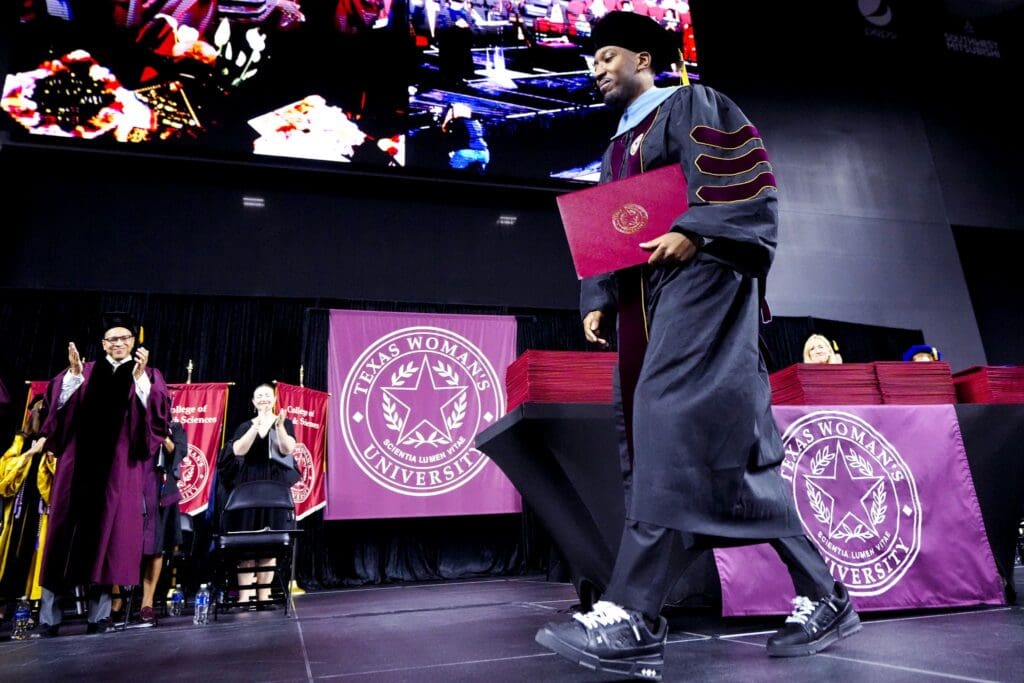
Dr. Daquan Minor, who was paralyzed from the waist down in a car accident in 2013, walks across the stage as he receives his doctorate in occupational therapy from Texas Woman’s University-Houston at the Fort Bend Epicenter in Rosenberg, Sunday, May 3, 2026. Minor used a device that electrically stimulates his nerves to use his legs to stand and walk.
Brett Coomer/Houston Chronicle
As Daquan Minor prepared to cross the graduation stage, his only thought was “Don’t fall.”
At 16, Minor was paralyzed from the waist down after a car accident. Doctors told him he would never walk again.
But on Sunday, he walked across the stage at Texas Woman’s University Institute of Health Sciences-Houston Center, as a newly graduated doctor of occupational therapy, using a device that sends electrical impulses to activate his nerves and muscles.
Advertisement
Article continues below this ad
As his mother, Quian Branon, watched him receive his doctorate, she thought of the much longer journey they’ve both taken over the last 13 years.
“It felt good. I had to hold all the tears in,” Branon said. “It was a struggle at first, but we came through. We weren’t about to give up. Once he made up his mind on what he wanted to do as far as his education, he did it and kept going.”
Want more Houston Chronicle?
Make us a Preferred Source on Google to see more of us when you search.
Add Preferred Source
A three-sport athlete with professional aspirations, Minor’s path changed abruptly at 16. He was a backseat passenger in a car accident that left him with a skull fracture and severe spinal cord injury. Minor was forced to pivot.
Advertisement
Article continues below this ad
Breakthrough in therapy
That pivot started with Lauren Proe and Yaronda Broussard, his first physical and occupational therapists. Every day, Minor would pull the covers over his face when they walked into his room. And every day, they reminded him to get up and put in as much work and time that he previously had dedicated to his basketball career.
For Proe, the breakthrough came during her last session with him, when Minor first turned one of his legs inward. Broussard said she saw the biggest change a little later, when he decided to pursue occupational therapy himself.
“I always told him he was beyond his years,” Broussard said. “(I saw) the change from teenage Daquan into understanding, ‘Life gives you obstacles and adversity, so what are you going to do with it?'”
Now at 29, they see him more as a colleague — and godson — than a former patient. The two joined several other former doctors, professors, family and friends to congratulate him after the ceremony.
Advertisement
Article continues below this ad
“I don’t forget any occupational therapist I’ve ever worked with, any physical therapist, any nurse, any physician. So all of this is a full circle of life for me,” Minor said. “Specifically, I’m graduating and becoming those who helped me when I first started off.”
Minor graduated high school two and a half years after his accident, where he walked the stage for the first time. He then pursued public health and human development and family studies at Lone Star College and the University of Houston.
Texas Woman’s University was the first and only school he applied to for his doctorate degree. The program gave him hands-on experience with students in Houston ISD, which he said cemented his calling.
He’s remained a popular face on campus ever since, said Texas Woman’s staff member Keithchell Taylor.
Advertisement
Article continues below this ad
“He means a lot to the campus, because he literally is the meaning of perseverance,” Taylor said. “In spite of everything, he keeps going, and I am just in awe of him. I can’t wait to see what else he has down the line for his career and his life journey.”
Taylor said she hopes to see him return to teach on campus one day, though Minor said he’s considering working in pediatric intensive care.
For now, he’s focused on passing the national board exam before beginning work and earning dual master’s degrees in business and health administration.
Advertisement
Article continues below this ad
Minor’s device began to misfire just before he walked the stage. As his name was called and the crowd rose to its feet for a standing ovation, he brushed away the jitters and stood tall. Halfway across, his mind drifted from “don’t fall” to the full circle of life — from sitting to standing, student to graduate, patient to doctor.
“After my injury, I knew I wanted to help people,” Minor said. “It’s a difference when you can empathize and sympathize with patients … when I tell the patient, ‘I understand. I literally understand, because I live this lifestyle.'”